

The Thailand EV market share 2025 story begins with a hard truth: a brutal price war is now rewriting Thailand’s automotive hierarchy. Chinese brands like BYD, Changan, and Great Wall dominate the EV segment through aggressive pricing and fast local assembly. Consumers are the winners as prices fall and choices expand. But the industrial losers are clear too—Japanese incumbents and local suppliers who now face shrinking influence and rising pressure.
BEV sales hit 54,084 units in H1 2025, soaring 61% year-on-year, and the market is on track for 100,000+ annual registrations. Chinese brands hold nearly 70-80% of this surge, reshaping sector expectations.
The 30@30 Reality: Thailand EV Market Share 2025 and the Policy Push
Thailand’s “30@30” target—30% EV production by 2030—has gained new momentum thanks to EV3.5 incentives and subsidies between 50,000–100,000 baht. Registration data shows how quickly the shift is happening.
H1 2025 EV registrations almost matched the full year of 2024. By the first seven months, EVs hit 66,000 units, rising toward 20% total market share. Electrified vehicles reached a 40.2% share in Q1, the highest in ASEAN. In short, Thailand is no longer inching toward 30@30. It is accelerating.
Read Also: EV Surge in Thailand: Registrations Up 45%
Chinese Brands Take Over: The Price War That Changes Everything
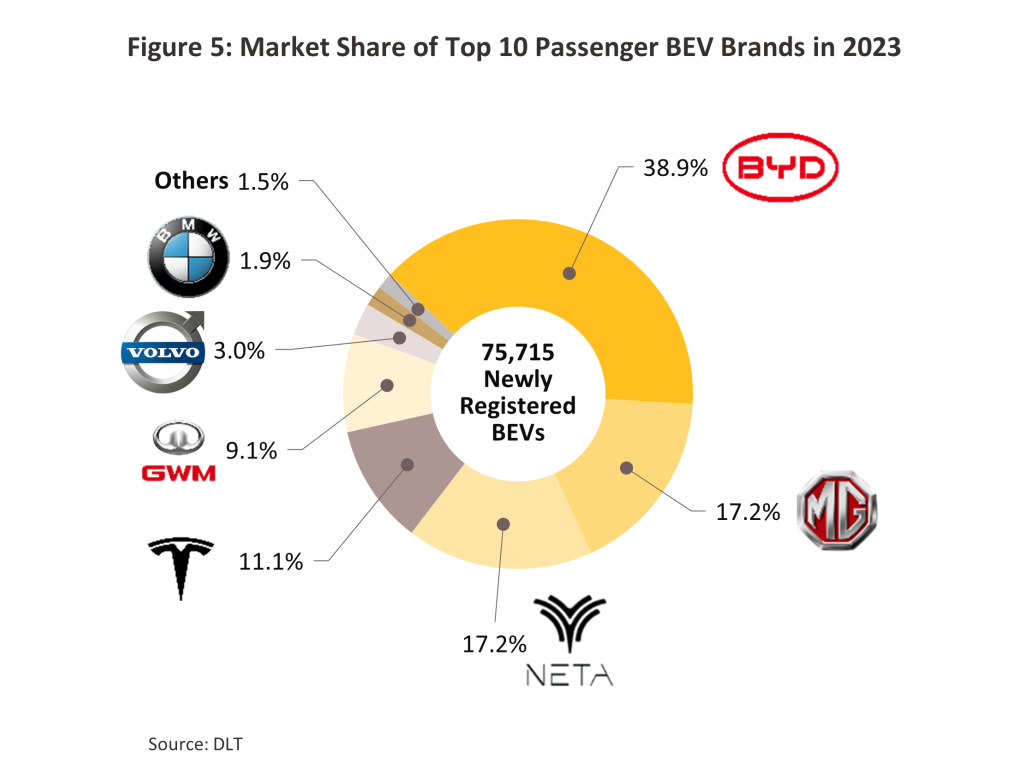
Chinese automakers now capture more than 80% of EV sales in Thailand. BYD alone secured 5.24% total market share in Q1, ranking fourth overall. Their strategy is simple but powerful: deep price cuts, rapid model launches, and local assembly to reduce costs.
This has ignited a price war. Overall car sales may be weak, but EV sales continue to soar, projected to increase by 40% in 2025. Consumers enjoy cheaper, well-equipped EVs. But Japanese makers, once untouchable in Thailand, now face their strongest challenge in decades.
Thailand EV Market Share 2025: A Pivot Back to Hybrids
Toyota and Honda still dominate overall sales, yet they are losing momentum in pure EVs. Their response is a strategic pivot toward hybrids—especially full hybrids (HEVs).
In Q1, hybrids led the electrified segment with 37,262 units and a 22.3% share, outperforming BEVs at 25,889 units. Models like Toyota’s Yaris Cross and Corolla Cross carry this momentum.
This hybrid-first strategy helps Japanese brands hold their ground, but it also shows they are choosing an incremental shift rather than jumping headfirst into the EV race.
Supply Chain Struggles of Thailand EV Market Share 2025
Local parts suppliers now face one of their hardest transitions ever. The shift to EVs demands new components, new machinery, and new skills.
Chinese makers are diverting more production to Thailand, increasing competition and pushing suppliers to adapt faster. Meanwhile, Japanese incumbents, once anchors for local manufacturing, are losing leverage in a rapidly consolidating market.
Looking Ahead: Strategic Insight for Investors and Businesses
The Thailand EV market share 2025 landscape shows a market transformed by pricing power, foreign investment, and shifting consumer expectations. To navigate this fast-changing space, companies need deep market understanding and strategic foresight. With over 40 years of distinguished experience, Thailand Mobility by Eurogroup Consulting offers unmatched expertise in market research and strategic advisory services in the region. Our committed team provides the insights and support needed to succeed in Thailand’s rapidly evolving automotive environment.